.avif)
🧘♀️ Why Stretching Alone Isn’t Enough (And What To Do Instead)
You’ve probably heard it before: “Just stretch it out!”
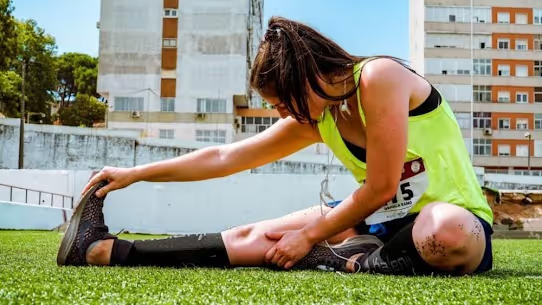
Whether it’s a tight hamstring, stiff back, or a cranky neck, stretching is often the go-to advice. But here’s the thing: stretching by itself won’t fix the root of most movement problems—and in some cases, it might even delay your progress.
🤔 So, what’s the real deal?
Muscle tightness is often a symptom, not the problem.
For example:
- A tight hamstring might actually be protecting a weak glute.
- A stiff upper back could be the result of hours of slouching—not a muscle that just “needs to loosen up.”
- Constant calf tightness? It could mean your ankle lacks mobility or your body is compensating for poor foot mechanics.
Stretching can provide temporary relief, but for lasting change, you need a more complete approach.
✅ What Should You Do Instead?
Here’s a more effective formula we often use with clients in the clinic:
- Mobilize – Loosen the joint, fascia, or soft tissue with dynamic movements or manual techniques.
- Try this: Foam rolling or active mobility drills before stretching.
- Try this: Foam rolling or active mobility drills before stretching.
- Activate – Wake up the muscles that should be doing the work.
- Example: After hip mobility drills, do glute bridges to activate your glutes.
- Example: After hip mobility drills, do glute bridges to activate your glutes.
- Strengthen – Reinforce your new range of motion with strength exercises.
- Why? Strength helps your brain “own” the new mobility so it sticks around.
- Why? Strength helps your brain “own” the new mobility so it sticks around.
- Repeat – Consistency > Intensity. A little bit regularly goes further than a lot once in a while.
🧩 Real-World Example
Let’s say you’re always stretching your hamstrings because they feel tight. You try foam rolling, yoga, or toe touches—but nothing seems to stick.
👉 When we assess a client like this in the clinic, we often find:
- Tight hip flexors pulling the pelvis forward
- Weak glutes not supporting the hip
- Poor core engagement leading to compensation with movement patterns such as squatting, walking/running or dead lifting.
The fix? Stretching might still be part of the solution—but we also retrain movement patterns, build strength in the hips and core, and work on posture.
💬 Takeaway
Stretching feels good, and it definitely has a place in your routine. But if you’ve been stuck in a cycle of stretch-pain-stretch-pain… it’s time to look deeper.
If you’re not sure where to start, we can help assess what’s really going on and design a plan that works with your body, not just against the tightness.